
Explore our guide for selecting between bulk and single-cell V(D)J sequencing approaches for discovery, development, and product quality control.
Key Takeaways:
- Biopharma programs should select an immune sequencing method based on analytical requirements and clinical research goals
- The most successful biopharma programs integrate both bulk and single-cell approaches strategically into their development pipelines
- Data quality is driven by platform architecture; iRepertoire’s optimized immune sequencing services deliver robust, reliable data that supports critical product development and clinical decisions
Introduction
As immune-based therapeutics advance from discovery into the clinic, immune repertoire profiling has become an essential tool for biomarker discovery, mechanism validation, and managing product quality control. With multiple sequencing approaches available, a critical question emerges early in program design:
Should you use bulk immune repertoire sequencing, single-cell V(D)J sequencing, or both?
The workflow you choose hinges on which specific questions you need to answer. Understanding the strengths and limitations of each workflow is key to selecting the method(s) that will generate the data needed to make critical product development decisions and to manufacture safe and effective immunotherapies.
Bulk Immune Repertoire Sequencing: Scale, Sensitivity, and Statistical Power
Bulk T cell receptor (TCR) and B cell receptor (BCR) sequencing remains the foundation of immune biomarker discovery in translational and clinical research.
Why bulk sequencing matters:
- Scale: Enables population-level immune profiling across hundreds to thousands of samples, essential for powering clinical studies
- Sensitivity: Detects rare but clinically meaningful clones, including minimal residual disease and early response indicators
- Statistical rigor: Provides robust measures of diversity, clonality, and repertoire convergence
- Cost-effectiveness: Delivers comprehensive data at a fraction of single-cell costs, making large cohort studies feasible
Importantly, chain pairing is not required to identify most immune biomarkers. Many validated clinical signals—response prediction, immune fitness, minimal residual disease—are driven by clonal dynamics rather than receptor pairing.
iRepertoire’s RepSeq+ advantage: RepSeq+ uniquely amplifies all seven immune receptor chains (TCR α, β, γ, δ, and IgH, Igκ, Igλ) or a subset of chains in a single workflow, providing unbiased, multi-lineage immune profiling with greater biomarker discovery power beyond TCRβ-only approaches and high reproducibility for clinical studies.
Best for: Biomarker discovery, immune monitoring, patient stratification, and translational trials
iRepertoire’s ImmunoSight™: ImmunoSight goes beyond bulk Adaptive Immune Receptor Repertoire (AIRR) and single-cell immune profiling to include quantitative gene-expression data from a customizable panel of 150+ immunophenotype genes, providing the comprehensive data needed to advance clinical development and drug-discovery programs.
Single-Cell V(D)J Sequencing: Pairing, Specificity, and Function
Single-cell immune profiling becomes essential when receptor pairing and cellular context are required.
What single-cell V(D)J sequencing enables:
- Native α/β, γ/δ, and heavy/light chain pairing at clonal resolution
- Direct linkage between clonotype and functional state
- Mechanistic understanding of antigen specificity
- Rigorous product characterization for cell and antibody therapies
Single-cell immune sequencing is particularly valuable for therapeutic antibody discovery, CAR-T and TIL product validation, and mechanistic studies of response and resistance. However, traditional microfluidic platforms often involve cell loss during encapsulation, reduced sensitivity to rare clones, and substantially higher per-sample costs.
iRepertoire’s iPair™ service: purpose-built for immune receptor pairing
Many single-cell services rely on wet capture or barcoding-based approaches that prioritize transcriptomic breadth over immune receptor sensitivity. iPair takes a fundamentally different approach designed specifically for high-confidence immune profiling:
- True single-cell capture without dilution through dry capture technology, maximizing PCR sensitivity for rare clones
- No droplet encapsulation or split-pooling losses, ensuring you don’t lose critical therapeutic candidates or mechanistic insights
- Direct library preparation that minimizes sample handling, reduces technical variability, and accelerates time to data
- Multiplex amplification of paired V(D)J chains simplifies workflows, reducing plate requirements and protocol complexity
- High pairing efficiency delivers faster results with confidence in data quality for decision-making
Best for: Cell therapy and antibody QC, mechanistic validation, antigen-specific clone engineering, therapeutic antibody discovery
When to Choose Each Immune Profiling Method: A Decision Framework
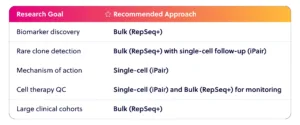
Integrating Bulk and Single-Cell for Translational Research
The most successful biopharma programs strategically integrate bulk and single-cell sequencing into their discovery and development pipelines. Each method serves to advance development at specific stages of the translational workflow:
- Bulk sequencing identifies disease and patient specific immune signals, cost-effectively, in large-scale screening studies aimed at biomarker and target discovery
- Single-cell sequencing resolves function, pairing, and specificity for mechanistic validation of clones of interest and quality control of manufactured products
Together, the two methods enable confident translation from discovery to the clinic. This integrated strategy has been demonstrated in landmark studies conducted by Emil Lou et al.1, and Asaf Poran et al.2 In Lou et al., the team linked repertoire diversity metrics with CRISPR-edited TIL efficacy, showing how bulk profiling guides product optimization. In Poran et al., researchers identified multi-chain immune signatures predictive of patient immunotherapy response, demonstrating the power of comprehensive receptor profiling. These studies demonstrate that selecting the right immune profiling method at each stage—combining bulk discovery with targeted single-cell validation—accelerates development while managing program costs.
Making the Right Choice for Your Program
Choosing the right immune repertoire workflow is about clinical intent and program strategy. iRepertoire uniquely supports both approaches:
- RepSeq+ for scalable, sensitive biomarker discovery that powers clinical decision-making
- iPair for precise single-cell resolution and therapeutic validation
Together, they form a cohesive immune intelligence platform built for real-world biopharma development, offering support from the first patient samples to therapeutic regulatory submissions.
Ready to compare workflows for your next study? Explore RepSeq+ and iPair solutions to build your optimal immune profiling strategy or connect with our immune profiling experts to discuss which method is right for your research or clinical objectives.
References
- Lou, E. et al. Targeting the intracellular immune checkpoint CISH with CRISPR-Cas9-edited T cells in patients with metastatic colorectal cancer: a first-in-human, single-centre, phase 1 trial. Lancet Oncol. 2025 May;26(5):559-570. Doi:10.1016/S1470-2045(25)00083-X.
- Poran, A. et al. Combined TCR Repertoire Profiles and Blood Cell Phenotypes Predict Melanoma Patient Response to Personalized Neoantigen Therapy Plus Anti-PD-1. Cell Reports Medicine. 2020 Nov;1, 100141. Doi:10.1016/j.xcrm.2020.100141.