
Abstract
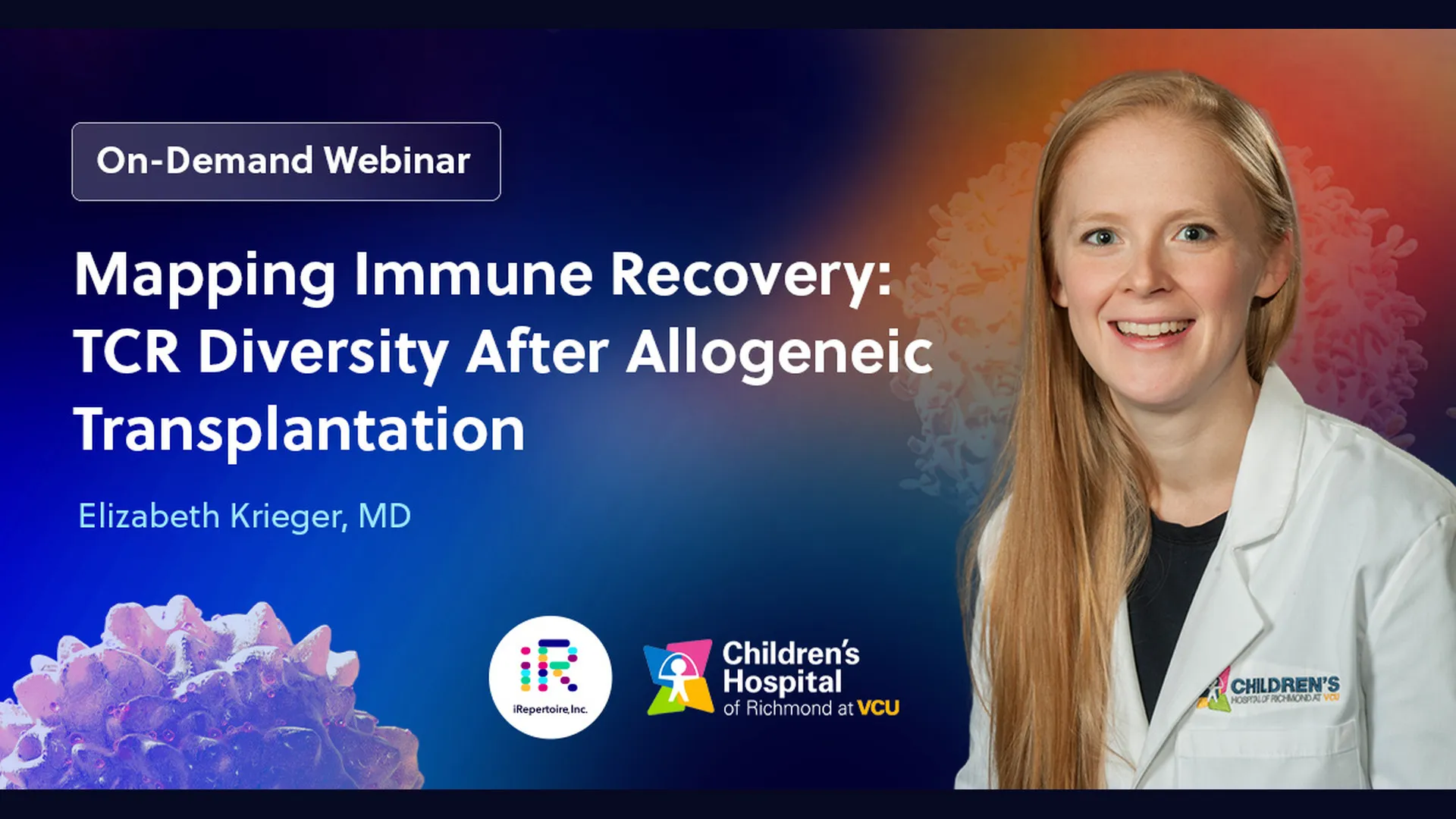
Post-transplant cyclophosphamide (PTCy) has transformed allogeneic hematopoietic cell transplantation (allo-HCT) by reducing graft-versus-host disease (GVHD), but its effects on T-cell receptor (TCR) repertoire reconstitution remain poorly understood. In this webinar, Dr. Elizabeth Krieger, Assistant Professor of Pediatrics at Children’s Hospital of Richmond at VCU Health, will present findings from a study of 35 patients with hematologic malignancies who underwent myeloablative allo-HCT with PTCy, examining TCR diversity and clonality across all four receptor chains (α, β, γ, δ) at baseline and at days 30 and 60 post-transplant.
Results revealed an early contraction of TCR diversity following transplantation, with Shannon diversity, Simpson evenness, and unique clone counts all declining sharply by day 30. Notably, donor age emerged as a significant factor in γδ T-cell reconstitution, with younger donors associated with greater early TRG and TRD diversity. Clinical events, including CMV reactivation and acute GVHD, were associated with oligoclonal expansions and rising dominant clone fractions, consistent with antigen-driven T-cell proliferation.
These findings highlight the early post-transplant period as a critical clinical window for monitoring immune recovery and informing intervention strategies.
Key Takeaways
-
PTCy-based allo-HCT causes a profound early contraction of TCR diversity across all four receptor chains, with the sharpest decline observed within the first 30 days post-transplant
-
Donor age, CMV reactivation, and acute GVHD are key clinical factors that shape early T-cell reconstitution, driving oligoclonal expansion and influencing immune recovery trajectories
-
Early post-transplant TCR clonal dynamics represent a critical clinical window that can inform targeted interventions to optimize long-term transplant outcomes
Speaker Bio
Elizabeth Krieger, MD
Elizabeth Krieger, MD, is an Assistant Professor of Pediatrics in Pediatric Hematology, Oncology, and Cellular Therapy at Children’s Hospital of Richmond at VCU. She serves as Director of Pediatric Stem Cell Transplantation and leads the Curative and Transformative Hemoglobinopathies Program, with a focus on expanding access to cutting-edge cellular therapies for children in Virginia. Her clinical and research work centers on hematopoietic cell transplantation, immune reconstitution, telomere biology, and improving outcomes for children with malignant and non-malignant blood disorders. She is also actively involved clinical trial development through the Children’s Oncology Group and the Bone Marrow Transplant Clinical Trails Network.